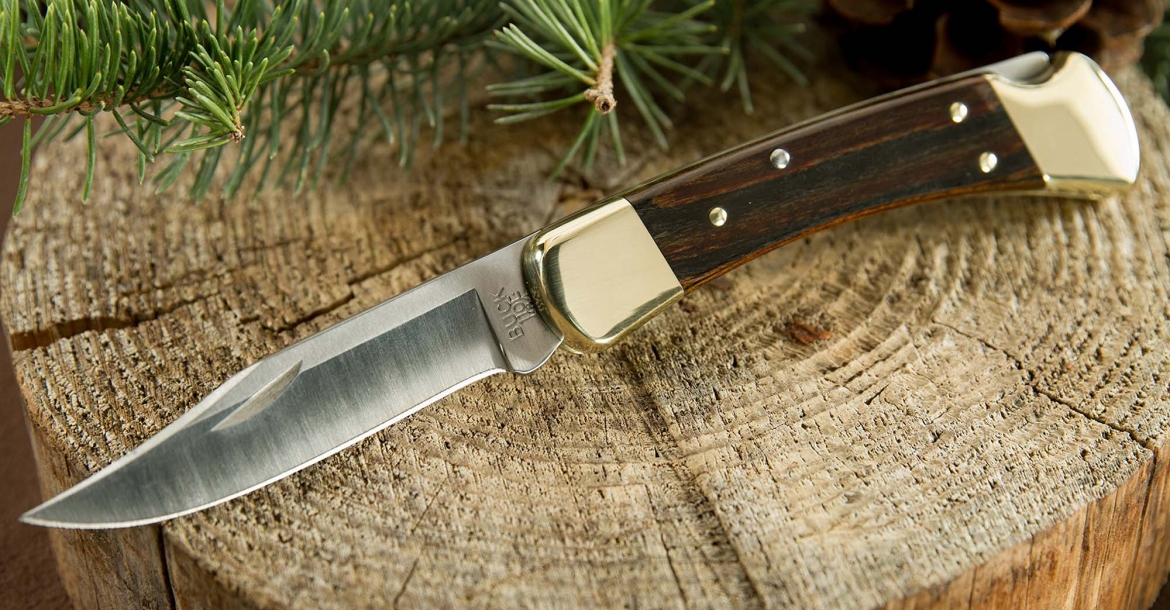
The Buck 110 Folding Hunter is an American icon, a folding knife that’s been a staple for hunters, survivalists, and EDC enthusiasts since 1964. Known for its rugged durability, classic brass bolsters, and ebony wood handle, the version with a notched handle (often featuring finger grooves for enhanced grip) adds a touch of ergonomic flair. In this review, we’ll break down the Buck 110’s specs with precise measurements, test its performance in survival and self-defense scenarios (mountain lion, bear, human), and compare it to modern EDC options like the Kizer Nice Guy.
Specifications and Measurements
Using a digital scale and caliper, we measured the Buck 110 Folding Hunter (standard 420HC steel, brass bolsters, ebony handle with finger grooves/notched variant) for accuracy:
- Weight: 7.2 oz (without sheath), 9.38 oz (with leather sheath). It’s hefty compared to modern EDC knives like the Kizer Nice Guy (2.6 oz), but the weight adds a reassuring solidity for rugged tasks.
- Blade Length: 3.75 inches (measured from tip to handle base), ideal for hunting and utility tasks but longer than many urban carry laws allow.
- Total Length: 8.625 inches open, 4.875 inches closed (measured end-to-end). It’s large for pocket carry but fits comfortably in the included leather sheath.
- Width (Handle): 0.55 inches at its thickest, with the notched ebony handle providing a contoured grip for secure handling.
- Blade Width: 0.12 inches (spine thickness), offering a balance of strength for slicing and light prying, though not as robust as fixed blades.
- Pocket Clip Deep Carry Exposure: The standard Buck 110 lacks a pocket clip, relying on a belt-mounted leather sheath (included). The sheath exposes about 0.5 inches of the handle for quick draw, but it’s less discreet than the Kizer Nice Guy’s deep carry clip (0.2 inches exposure).
The notched handle (often with finger grooves, as seen in models like the Buck 110 Finger Grooved variant) enhances grip security, especially in wet conditions, making it a favorite for hunters and outdoor enthusiasts. The 420HC stainless steel blade, heat-treated by Buck’s renowned Paul Bos process, offers excellent edge retention and corrosion resistance for its price point.
For survival tasks, the Buck 110 handles light batoning and feather-sticking but isn’t suited for heavy chopping—opt for a fixed blade like the Buck 119 Special for that. Its leather sheath is durable but less versatile than the Kizer Nice Guy’s deep carry clip for quick access.
Design and Build Quality
The Buck 110 Folding Hunter is a timeless design with polished brass bolsters and Crelicam ebony wood scales, often featuring finger grooves or notches for improved ergonomics. The notched handle variant (e.g., the Buck 110 with finger grooves) provides a contoured grip that locks your hand in place, reducing slip during heavy cutting. The nail-notch lockback mechanism requires two hands to open but ensures rock-solid blade stability, rivaling fixed blades for strength.
Self-Defense Capabilities
While folding knives aren’t primary self-defense tools, the Buck 110’s robust build and sharp blade make it a viable last-resort option. Here’s how it fares in the requested scenarios:
Mountain Lion: The Buck 110’s 3.75-inch blade is long enough to deliver deep slashes or thrusts to deter a mountain lion, targeting sensitive areas like the eyes or nose. Its lockback mechanism ensures the blade won’t collapse under pressure, unlike some liner locks. However, its two-handed opening slows deployment compared to the Kizer Nice Guy’s flipper. A fixed blade or bear spray is preferable for big cats.
Bear: Against a bear, the Buck 110’s blade length and 0.12-inch thickness are inadequate for stopping a charge. Deep penetration is needed, and a 3.75-inch folder falls short compared to a fixed blade like the Buck 119 (6-inch blade). Use it for desperate slashes to create an escape opportunity, but bear spray is the gold standard for bear defense. Human: For human threats, the Buck 110’s solid lock and sharp blade make it effective for slashing or thrusting in a pinch. The notched handle ensures a firm grip under stress, but the two-handed opening is a drawback compared to the Kizer Nice Guy’s one-handed flipper. Training is critical—de-escalation and legal compliance should always come first.
We compared the Buck 110 to the Kizer Nice Guy and Buck 112 Ranger for context:
Kizer Nice Guy: The Nice Guy (2.84-inch Nitro-V blade, 2.6 oz) is lighter, slimmer, and has a modern flipper action, making it better for discreet EDC. However, its shorter blade and thinner spine (0.11 inches) are less suited for heavy tasks like the Buck 110’s field dressing or light batoning. The Nice Guy’s deep carry clip (0.2-inch exposure) beats the Buck’s sheath for pocket carry. Watch our YouTube video for a cutting test comparison. Buck 112 Ranger: A smaller sibling to the 110 (3-inch blade, 5.6 oz), the 112 shares the same 420HC steel and brass/ebony notched handle design. It’s more pocket-friendly but less capable for heavy-duty tasks. Both are iconic, but the 110’s longer blade suits hunting better.
Purchase the Buck 112 Ranger on Amazon: Buck Knives 112 Ranger Lock-back Knife, Brass Bolsters, Ebony Handles, 3″ 420HC Blade
Purchase the Kizer Nice Guy on Amazon: Kizer Nice Guy Pocket Folding Knife, 2.84″ Nitro-V Blade Pros and Cons
Pros:
- Iconic design with brass bolsters and notched ebony handle for secure grip. 420HC steel blade (3.75 inches) is sharp, corrosion-resistant, and easy to sharpen. Robust lockback mechanism rivals fixed blades for strength. Included leather sheath is durable and stylish for belt carry. Backed by Buck’s Forever Warranty.
- Versatile for hunting, camping, and light survival tasks.
Cons:
- Heavy (7.2 oz) and lacks a pocket clip, less ideal for EDC compared to the Kizer Nice Guy. Two-handed nail-notch opening is slower than modern flippers.
- 420HC steel, while reliable, lags behind premium steels like S30V or MagnaCut.
Conclusion
The Buck 110 Folding Hunter with standard 420HC steel, brass bolsters, and a notched handle is a legendary knife that blends heritage with utility. Its 3.75-inch blade and sturdy lockback make it a powerhouse for hunting, camping, and survival tasks, while the notched handle ensures a secure grip. Though heavier and less pocket-friendly than modern EDC knives like the Kizer Nice Guy, its durability and classic style are unmatched for the price. For self-defense, it’s a capable last-resort tool, but its two-handed opening limits speed.
Watch our YouTube video for a full review, including cutting tests and comparisons with the Kizer Nice Guy and Buck 112 Ranger. If you want a reliable, heirloom-quality knife that’s built to last, the Buck 110 is a must-have.